
What Is Collaborative Filtering?
The core idea fits in a single sentence: people who agreed in the past will probably agree again.
That is the whole premise. In other words, the system does not study the song itself. Instead, it studies the behavior of the people who play it.
- It ignores the content entirely, so it needs no audio, no lyrics, and no tags.
- Behavior drives everything, meaning plays, ratings, skips, and purchases.
- The same math works in almost any field, because it can sort films, shoes, and job listings.
- Scale helps too, since more users means more overlap to learn from.
That is why collaborative filtering shows up everywhere. Once you know who played what, you can predict what someone wants next without ever hearing a note.
The Two Main Types of Collaborative Filtering
User-Based Filtering
In short, this version looks for people whose behavior resembles yours. Then it hands you what they liked.
- First, the system builds a profile of everything you have played.
- Next, it finds the users who overlap with you the most.
- Finally, it shows what those users liked that you have missed.
Picture a friend with similar taste passing you a record. However, the catch is cost, because checking every user against every other user takes real computing power. Taste also shifts from week to week.
Item-Based Filtering
This version flips the question. Instead of comparing people, it asks which songs get liked by the same crowd.
- If most people who play track A also play track B, the two count as similar.
- Instead, the link sits between songs rather than people, which makes it far more stable.
- The pitch becomes simple: you liked A, and B is close to A.
As a result, item-based filtering scales better, which is why most companies rely on it. Song pairs change slowly, but your mood does not.
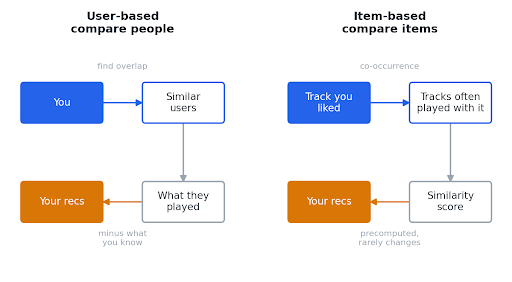
Figure 1: The same goal, two directions of comparison. Item-based filtering wins in production because item similarity can be worked out ahead of time. ( image created in canva)
How Collaborative Filtering Works Under the Hood
Underneath it all sits one enormous table. Users fill the rows, songs fill the columns, and each cell holds a single fact: a play, a rating, a purchase, or nothing at all.
- Because nobody hears more than a sliver of any catalog, most of the table sits blank.
- That blankness has a name, and it is called sparsity.
- The job of the model is to predict the missing cells.
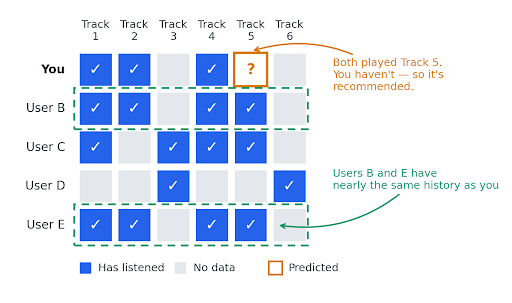
Figure 2: A collaborative filtering user-item matrix. The app never hears the tracks. It only sees who played what, then fills the gaps from histories that overlap. (image created in canva)
Matrix factorization is the standard approach. First, it splits the huge table into two smaller ones. Then multiplying those together produces a close copy of the original.
Along the way, the model discovers hidden traits. For example, some traits track how harsh a song is, while others track how old it is. Nobody labeled them, because they fall out of the behavior data on their own.
- The idea took off during the Netflix Prize contest, and the standard paper on matrix factorization is still the clearest source for the math.
Two Kinds of Signal
- Explicit signals are deliberate, like a star rating, a thumbs up, or a saved track.
- Implicit signals come from habit, like a full play, a skip at eight seconds, or a replay.
- Star ratings are clean but rare, because most people never rate anything.
- Habits are plentiful but murky, since a skip might mean dislike or might mean a phone call.
So most modern systems lean heavily on habits and weigh each one by confidence. After all, a song played thirty times says far more than a song played once.
Where Collaborative Filtering Breaks Down
This method fails in well-known ways. In fact, those flaws explain most of the strange picks you have seen.
The Cold Start Problem
- A brand new song has no history, so nothing can match it to anything else.
- Likewise, a brand new user has no profile, so the system cannot place them.
- A great track uploaded this morning stays completely invisible.
This is the single biggest flaw, and it hits independent artists hard. It is also why apps ask you to pick a few favorite bands when you sign up, since that step patches this exact gap.
Popularity Bias
- Meanwhile, popular songs appear in far more listening histories than deep cuts.
- More histories mean more recommendations, which drives even more plays.
- The loop feeds itself, and smaller acts stay buried.
The Filter Bubble
- Your recommendations come from what people like you already play.
- So music that sounds new to you has no easy path into your feed.
- Systems fight this by injecting some variety on purpose.
There is a real trade-off here. A system tuned purely for accuracy would show you what you already know you like. But that is not the same as being useful.
How Hybrid Systems Fix the Gaps
These flaws are built in. For that reason, real products rarely use collaborative filtering alone.
- Content analysis studies the song itself, measuring tempo, tone, and shape, so a brand new track can be matched on day one. Our guide to how digital audio works covers the raw data this runs on.
- Also, text mining reads reviews and playlists to learn how people describe a song in words.
- Context signals track time of day, device, and activity, because a morning commute is not a Friday night.
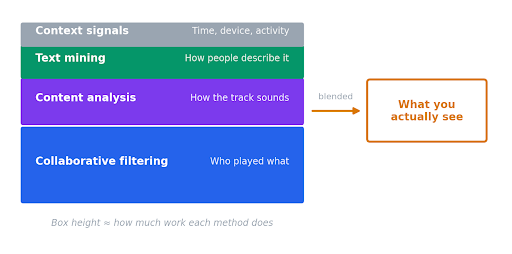
Figure 3: A real recommendation engine blends several methods. Collaborative filtering does most of the work, and the others cover its blind spots. (image created in canva)
Collaborative filtering still does most of the heavy lifting, while the other methods cover its blind spots. To see one real product up close, read our breakdown of how Spotify’s algorithm works.
Why Collaborative Filtering Matters Beyond Music
This is not a music technology. Rather, it is a general pattern that appears wherever software has to predict what a person wants.
- Retail sites use it for customers who bought this also bought that.
- Video platforms use it for the row of recommendations on the home screen.
- Job sites use it for suggested roles and connections.
- Learning platforms use it to pick your next course based on your group.
- Workplace tools use it to surface relevant files and documents.
So if you work anywhere near data, you will meet this pattern. Spotting it explains a lot of software behavior: the strange pick, the item that never appears, and the suggestion that lands suspiciously fast.
Common Questions About Collaborative Filtering
Is collaborative filtering the same as machine learning?
Not quite. It is one technique inside the much broader field of machine learning. Modern versions do lean on machine learning methods, but the basic idea is decades older than the term.
Does collaborative filtering need my personal data?
It needs your activity rather than your identity. The math runs on patterns of plays and ratings, and those patterns work even when names are stripped out. Even so, listening history is still personal data, and privacy rules treat it that way.
Why do I keep getting the same recommendations?
Usually that is popularity bias and the filter bubble working together. Because your feed gets built from what similar users already play, unfamiliar music has no easy route in.
Wrapping Up
Collaborative filtering is one of those ideas that looks too simple to work. The system never listens to a single track, and it still lands the right pick more often than not. But its blind spots are just as easy to predict as its strengths, which is why no serious product leans on it alone.
Here is what to take away.
- Collaborative filtering predicts what you want from the behavior of similar users, and never studies the item itself.
- User-based filtering compares people, while item-based filtering compares items and scales better.
- Matrix factorization fills a mostly empty table and discovers hidden taste traits along the way.
- Habits now matter more than star ratings.
- Cold start, popularity bias, and filter bubbles are built-in flaws rather than bugs.
- Real systems blend several methods together to cover those gaps.
Knowing how everyday software works makes you better at choosing it, buying it, and building it. LearningComputer.com publishes clear technology guides for people who want to understand their tools. Browse our library to keep building your skills.
